Because grown-up friendship is a skill, not a accident — and you can absolutely get better at it.
Nobody warned us that at some point in our 30s, we’d be googling “how to make friends as an adult” at 11pm, slightly mortified but also… desperate. If that’s you right now, firstly: you’re not alone. Secondly: let’s fix it.
Somewhere between your 20s and now, the easy, osmosis-style friendships dried up. No more shared seminar rooms. No more house parties where you’d end up talking to a stranger for three hours and somehow become best mates. Now everyone’s busy, scattered, and vaguely tired. And you? You’re wondering if this is just… it.
It’s not. Making friends in your 30s and 40s is genuinely possible — it just requires a little more intention. Think of it like learning to cook properly after years of toast: slightly more effort, but the results are so much better.
Why Is It Harder to Make Friends After 30?
Let’s be honest about this first, because the struggle is real and it deserves acknowledgment. In your teens and 20s, proximity did the heavy lifting. School, uni, shared houses — you were constantly thrown together with people and friendships formed almost by default.
Now? You choose your environment far more deliberately. Your commute is to a home office. Your weekends are full. Your social energy has a hard limit, and you’re very selective about how you spend it. That’s not a flaw — that’s just life at this stage.
Research backs this up too. Sociologist Rebecca Adams has noted that adult friendship requires three key conditions: proximity, repeated unplanned interaction, and a setting that encourages people to let their guard down. All three are essentially built into student life. After 30? You have to engineer them yourself.
Add in the invisible weight of social anxiety (which affects a surprising number of women — and rarely gets talked about), the exhaustion of work and family, and the very real fear of rejection from a stranger, and honestly, it’s a miracle anyone makes new friends after 30 at all.
But they do. You can too.
The Honest Bit
Yes, It’s Normal to Feel Like You Have No Friends
This one is important. Loneliness in your 30s and 40s is startlingly common, and still weirdly taboo. A 2023 report by the Campaign to End Loneliness found that millions of adults in the UK experience chronic loneliness — and women in midlife are particularly vulnerable, especially after major life transitions like moving cities, having children, or career changes.
Worth knowing
Feeling lonely doesn’t mean you’re unlikeable or broken. It often just means your social structure changed and your friendships haven’t caught up yet. That’s a circumstance problem, not a you problem.
Acknowledging this isn’t wallowing — it’s the first step to actually doing something about it.
Where to Actually Meet People (When Bars Aren’t Your Thing)
Good news: you don’t need to force yourself into loud pubs or awkward networking events. There are far better options — especially if you’re willing to go where your interests already live.
Places that genuinely work
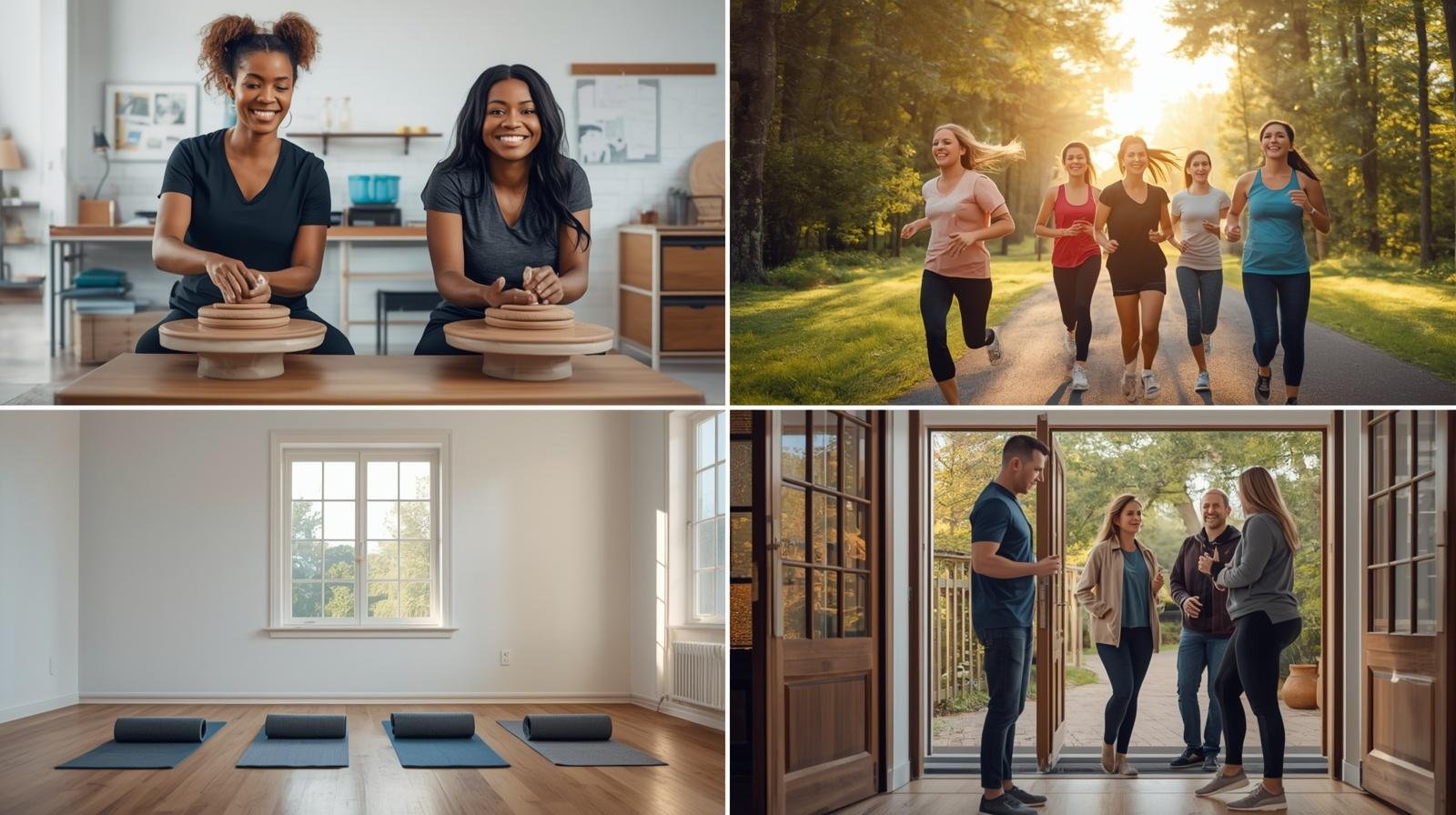
- Classes and courses — pottery, life drawing, creative writing, book clubs, running clubs. The repeated contact is built in.
- Volunteering — one of the most underrated friendship routes. Shared purpose creates real bonds fast.
- Local interest groups — check Meetup.com, Facebook Groups, or Eventbrite for everything from wild swimming to board game nights.
- The gym, yoga studio, or park run — regularity builds familiarity. Say hi enough times and a conversation usually follows.
- Work — but carefully — colleagues can become friends, but it takes initiative beyond the Teams chat.
- Your kids’ school gate — awkward, yes. But also a rich seam of potential, especially if you actively push past the pleasantries.

The Practical Part
How to Turn Acquaintances Into Actual Friends
This is where most people get stuck. You have the gym person. The school gate mum. The colleague you always get on brilliantly with. But it never goes anywhere.
Here’s the uncomfortable truth: someone has to make the first move. And in adulthood, that someone is usually whoever cares enough to try.
- Be specific, not vague. “We should hang out sometime!” is a social dead end. “Do you want to try that new café on the high street Saturday morning?” is an actual invitation.
- Accept that it’s going to feel slightly weird at first. That’s fine. Push through it.
- Follow up after you meet. A simple “I really enjoyed that, shall we do it again?” goes a long way.
- Invest consistently. Friendships at this age don’t just happen — they need regular deposits of time and attention to grow.
- Show genuine curiosity. Ask questions. Remember what people tell you. People don’t forget feeling truly seen.
It sounds simple because it is. It’s also terrifying. Do it anyway.
Dealing With Social Anxiety When Making Friends as an Adult
If putting yourself out there brings on a low-grade dread — the rehearsed conversations in the shower, the post-event spiral of “was I too much / not enough?” — you’re in good company. Social anxiety doesn’t magically disappear when you turn 30. If anything, the stakes feel higher.
A few things that actually help:
- Start in structured environments (a class, a club) where the social script is clearer and the pressure is lower.
- Give yourself a small, specific goal: “I’ll say hello to one new person today.”
- Reframe rejection. Someone not clicking with you isn’t a verdict on your worth — it’s just incompatibility.
- If anxiety is significantly limiting your life, talking to your GP or a therapist is genuinely worth it. CBT in particular has a strong evidence base for social anxiety.
A gentle reminder
Most people are too busy thinking about how they’re coming across to judge you as harshly as you judge yourself. Truly.
Friendship Apps — Gimmick or Genuinely Useful?
Yes, friendship apps are a thing. Bumble BFF, Friended, and Hey! Vina are all designed specifically for platonic connections. And honestly? For some women, they work brilliantly — especially after relocating, or if you have a very niche interest and can’t find your people locally.
| App | Best for | UK availability | Verdict |
| Bumble BFF | General friendship matching | ✓ Yes | Most established, solid user base |
| Friended | Interest-based matching | ✓ Yes | Good for niche connections |
| Hey! Vina | Women only | Limited | Smaller but more curated feel |
| Meetup.com | Group activities | ✓ Yes | Best for actually doing things together |
The caveat: apps get you to a first meeting. The real work starts there. Don’t confuse matching with actual friendship.
Life Stages & Logistics
Navigating Different Life Stages (Parents vs Non-Parents)
One of the trickier bits of making friends in your 30s and 40s is that everyone is at wildly different points. Some of your peers have three kids and zero time. Others are child-free and booking last-minute city breaks. A new friendship across that divide is absolutely possible — but it requires flexibility and genuine interest in each other’s lives, not just assumed common ground.
If you’re a parent trying to connect with other parents beyond school-gate small talk, suggest low-stakes activities the kids can come to: a park afternoon, a soft play (yes, you’ll hate it, but the conversation can be good). If you’re child-free, be the friend who makes plans that work for them occasionally — it’s noticed, and appreciated.
How to Maintain Friendships When You’re Genuinely Stretched
You don’t need to see someone every week for a friendship to be real. But you do need consistent, genuine contact. A few ideas:
- Voice notes over texts. Quicker to send, more intimate to receive. A game changer for long-distance or busy friendships.
- The standing date. A monthly walk, a quarterly dinner — calendar it and protect it.
- Low-effort check-ins. A funny meme. A “this reminded me of you” article. Presence doesn’t always require a three-hour catch-up.
- Be honest about capacity. “I’m a bit buried right now but I’m thinking of you — can we plan something for next month?” is a complete, valid message.
Signs a New Friendship Is Worth Investing In
Not every person you meet is going to become a close friend, and that’s fine. But when you’re building from scratch, it helps to know what you’re actually looking for. Healthy, worth-it friendships tend to feel:
- Reciprocal — they reach out too, not just when they need something
- Easy in the right ways — you can be quiet together, disagree without drama
- Energising, not draining (most of the time)
- Safe — you’re not editing yourself into oblivion to be liked
Letting Go of Old Friendships That No Longer Fit
This one is painful and rarely discussed. Some friendships have a natural lifespan — and holding onto ones that have run their course out of habit or guilt doesn’t serve either of you. You’re allowed to let relationships quietly fade. You’re also allowed to feel sad about it without it being a failure.
The ones worth fighting for? Those require honest, kind conversations when things feel off. Most adult friendships don’t end in drama — they just drift. Sometimes a gentle nudge back is all it takes.

FAQs
Quick-Fire Questions Answered
Is it too late to build a social circle from scratch in my 40s?
Absolutely not. It’s slower and requires more deliberate effort than it did at 22, but women build rich, meaningful friendship groups well into their 40s, 50s and beyond. The friendships tend to be higher quality too — because you know yourself better and you choose more intentionally.
What if I keep getting flaked on or plans fall through?
Don’t take it personally straight away — adult life is genuinely chaotic. But if someone consistently cancels, deprioritises plans, or only reaches out when they need something, trust that pattern. Your time is finite. Invest it where it’s valued.
How many friends do I actually need?
Fewer than you think. Research suggests that most people have just three to five truly close friends at any given time. Quality really does matter more than quantity — especially at this stage of life.
You’re Not Behind. You’re Just Building Differently.
Making friends as an adult is awkward, effortful, and occasionally mortifying. It’s also one of the most worthwhile things you can invest in for your mental health, your happiness, and your life. Start small. Start somewhere. Start today.